Showing posts with label red dirt. Show all posts

Wednesday, October 10, 2012

Perilous journeys and additions to the family

For the few of you reading my blog, you know that I travel a lot in to the interior. Some of you also know that Liberia receives one of the highest rainfalls in the world. Traveling during rainy season is quite painful. The tracks are rough, the small portion of paved road is washed away, and the roads look like meteors crashed everywhere. Work and life doesn't stop because of the rainy season...we keep chugging along! Monrovia receives the most rainfall compared to any capital city in the world. Liberia, being the last vestige of the West African rain forest, receives an incredible amount of rain. I have lived in tropical countries before, but I have never experienced this kind of rain. Imagine a heavy downpour for 9 days NONSTOP! Not even a short beak, it pours incessantly for days at a time. And it is not even a drizzle, it is serious downpour. In one week, the paint on buildings washes away, shanty towns collapse and submerge in water, and you feel like you are going to be washed away in to the sea. It is beautifully cathartic in a way...the incessant rain washing away everything in its way.

The latest trip was particularly painful. It took us 14 hours to travel 250 miles. Thank goodness for Toyota! We would never get anywhere if it isn't for these trusty Land Rovers. Besides getting stuck in 6 foot deep mud pits, we had to wait for the trucks to pull themselves out of the mud so we can keep going. I am posting a few pictures that show the road condition. Look at that mud pit! A car dropped in to the pit just before us and it was struggling to get out...that's the smoke you see in the picture.


Despite these road conditions, people still travel in the interior. They have to, in order to sell their goods, produce, livestock. Note the goats and chickens sitting on top of a truck in the picture below. The truck was waiting along with us for clearance because the van in front of it is stuck in the mud.


Note that the goats are sitting on top of a hospital vehicle. Isn't that funny? Here is a close up of the goats waiting patiently on top of the same hospital vehicle. Can you tell I like goats? Of course, this picture is not for the PETA-loving folks!

Goats

How does Dr. V manage through this mess? Well, stylishly of course! Look at me waiting for a truck to clear itself out of the mud... what's going on with my hair in this picture?

ME!

However, this stylishness disappears once I get in the mud and start digging our trusty Land Rover out of a mud pit in a heavy downpour at 9pm in the middle of the jungle. Yeah, that happened last month! I took off my pants, jumped in to rain gear and started digging along with my driver. What else are we going to do, sit there and wait until someone appears and pulls us out? That could take all night! We took matters in to our own hands and got out of that pit. Sorry, no pictures of that incident. No picture taking when you are covered in mud and soaking wet from the rain. I looked like I am having a mud wrap, not in a fancy spa but the Liberian jungle.

At times we wait for hours because the vehicles in front of us get stuck and there is no way to pass. Two weeks ago (before the fateful tear gas incident), I went to Voinjama. It is a town on the far north end of Liberia, about 10 miles from Guinea. In fact, most people in Voinjama buy their goods at the markets in Guinea because of proximity. It took us 14 hours to get to Voinjama with only pit stops. On the way back we got stuck behind a truck that was carrying people and goods from Guinea. As with most transport in West Africa, it was carrying more than it could/ should. Combine the load with the road conditions in Liberia and you have a disaster. The truck got stuck in the mud and all the people traveling on top of the goods got off and started pushing. See picture below.

Truck stuck in the mud

Now you may wonder why the truck is so deep in to the road. Well, the truck was so heavily loaded that it sank in to the mud and the revving only pushed it deeper in to the ground. The goods you see in the truck are after they unloaded almost half of the original load. Notice the bags of onion in front and white rice bags in the back?

Then there was another truck that was coming from the opposite side and got stuck next to this one, effectively blocking traffic on both sides.

Blocked traffic

While there is usually no upside to getting stuck behind a truck in the middle of the jungle, I managed to find one. One of the ladies traveling on top of the truck, who got off the truck because it is stuck, was going to the market to sell her "goods". Goods meaning jungle tortoises. LIVE!! I saw her sitting on the mud road hoping for the truck to clear so she can make some money by selling her tortoises. At first I didn't believe that they were live and then I noticed their little heads poking out to see what is going on. I jumped in joy and immediately bought all tortoises she had (only two). The locals eat them...they would have ended up on somebody's dinner plate. Instead, they are now at Coconut Plantation House #12, safe and sound. Michael named them Samson and Delilah without knowing which one is male/ female. We realized the next day we named them correctly when Samson was looking for love from Delilah (I will spare the details!).

My local staff tell me that both tortoises are at least 50 years old considering their size, color, and rings on the shells. They are the West African Hingeback tortoises. Here is a picture of Delilah peeking out of her shell. Samson is camera shy. They like walking around the house and hiding. Who knew tortoises are fast?!
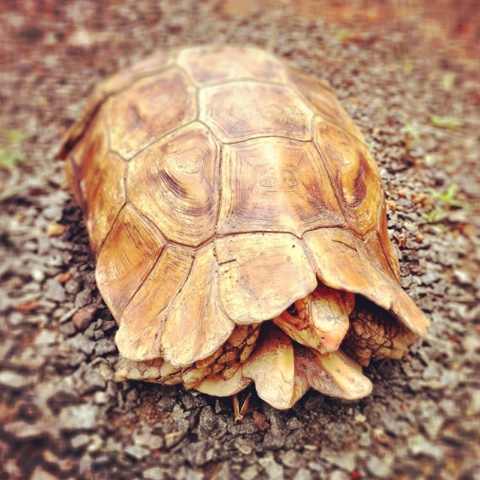

Delilah
I have a feeling my internal organs are displaced from traveling on these horrible roads, but they all seem to be functioning well. So, that's it for now. I will give the tortoises a bath while you enjoy the pictures. 

Thursday, June 14, 2012

When the clouds come rolling in...

Last week I traveled to Sanniquellie for two reasons. One was to conduct a workshop for the health workers on using data for making decisions. The other reason was to explore why contraceptive use is very low in Nimba County. I will write about those two parts later, I have to talk about the drive to Sanniquellie.


The better part of the road - with few potholes and washed away at its seams
I like driving up country, or as the Liberians call it, "the bush". The drive from Monrovia to Sanniquellie is quite the feat, because of the road. I haven't been to Sanniquellie in a month, so I wasn't aware of the condition of roads. The terrain changes rapidly in the rainy season, because it doesn't just rain here. The rain in Liberia is unlike any other. It is powerful enough to wash away everything in its path. To give you an idea, Liberia received the third largest rainfall in the world, for its land area. Monrovia is the city with the highest rainfall in the world. Since the rainy season started a month ago, I wasn't quite sure what lay ahead in front of us. Well, not much lay ahead. The dirt road that has washed away in most areas leaving huge potholes the size of craters, and rocks. Part of the road is paved. the part from Monrovia to Gbarnga is not bad, the part from Gbarnga to Ganta is the worst, and from Ganta to Sanniquellie is just track. Half of our journey is spent clinging on to our dear lives on the hand railing in our Land Cruiser. I do not recommend anyone with a bad back doing this trip.

However, not all is bad. The scenery is beautiful. That's what happens when you drive through the last remaining rain forest in West Africa. Lush tropical forest lines either sides of the road. Huge rubber trees stand majestically among the underbrush. The Liberian rain forest is also the world's only known habitat for pygmy hippos. I haven't seen one in the wild so far, because they are rare, shy, and highly endangered.

Since it is the rainy season, and these are no ordinary rains, you always are caught in a downpour. The sight of a rain storm rolling in always enthralls me. The colors - green luscious forest, red dirt road, the blue sky, and black clouds rolling in with immense speed - is quite the sight to see. Although I am no professional photographer, I tried to capture some of the intense beauty with my simple yet trusty Canon Powershot.

The clouds roll in...

What you see on the right is a small hamlet, three huts bordered by plantain and coconut trees. I asked our driver to stop in the middle of the track so I can marvel at the beauty of nature. I started taking pictures and a man came out of one of the huts to see what we were doing. After some more picture taking, we resumed our bumpy journey.

The dark sky and darker road

As we pass through more forest and start driving through the heavy downpour, we are greeted with various sounds from the forest, people running to their huts to avoid the rain, and, my most favorite of all, the smell of  earth when it receives rain. After about an hour of driving, we finally get past the rain, and start watching for the huge puddles on the road. It is a good thing we have the trust Land Cruiser, you cannot do this drive with many SUVs.

One of the things you have to be cautious of this rain is the huge puddles that form in the road. It is difficult to  avoid and gauge the depth of these puddles, which leads to many accidents. These are no ordinary puddles, they can swallow half of your car easily. We witnessed one such accident. A semi-truck that got stuck in one such puddle because it was too deep. The semi kinda nosedived in to one puddle while avoiding another puddle. Luckily there were no casualties, just a semi stuck on the road. This does not bode well for us, because you cannot take a diversion.


Accident!

Now, you may wonder why there is a big semi in the middle of the rain forest? It is because one of the largest iron ore mines in Africa is located near the Liberia-Guinea border, in a town called Yekepa. You have to pass through the rain forest to reach Yekepa. Arcelor Mittal has a huge mining operation going on in Yekepa, and this particular truck was delivering some supplies to the mine.

We got out of our SUV, walked around to see if there is any clearing on the side of the road and decided to take a chance with off-roading. There is no way we are staying stuck in the forest behind this semi, while it is getting dark. Look at my boss and our driver surveying the terrain.


My boss and driver surveying the terrain before deciding if we can off-road

My boss drove Land Cruisers in the rain forests of Cameroon 30 years ago, while volunteering as a physician in the jungles of Cameroon and Congo. He has worked extensively in Africa and he has a great knowledge of the terrain. With his and our trusty driver's skills, we were able to get out of this road block. Look at our intern waiting patiently and watching the scene.


Heather waits patiently while enjoying the scenery

That's our trusty Land Cruiser, by the way. Almost all international donors and NGOs working in Liberia have white vehicles. The rhino horn looking thing in front of the car is for our satellite phone, if we get stuck in the jungle and need the American government to come get us :) After some maneuvering, we were able to get on the road and resume our journey. We got out to see the accident from the front and it looked like this...


The accident from the front

Well, that crash could have easily been us. But we have skilled drivers, so I rarely get worried about driving through the rain forest. Just look at that lush greenery on either sides of the road. Stunning!

We go on with our journey and arrived at Sanniquellie safely. Finished work in two days and came back to Monrovia. I bought a big bag of palm nuts for Isaiah on the way back home. He is one happy bird!


Friday, April 20, 2012

How to transport goats?

On a pen-pen, naturally! Duh!!

Over the weekend I traveled to Buchanan - capital of Grand Bassa County - to assess the state of the county health services and system. It is only a 2.5 hour drive from Monrovia, so I left on a Sunday afternoon (after a great buffet lunch at the Royal Hotel...something to talk about another time) around 3PM to arrive in time. On our way we discover that a road construction company is blasting a hill to make way for the road. We stopped and waited for the blasting to be finished so we can keep driving without being hit by flying rocks. While waiting for the blasting to be finished, I got out of the vehicle to walk around (there was a river nearby). Many people were waiting with us and I noticed a lot of motorbikes and some cars behind us.

While walking towards the river I hear sounds. I immediately recognize it is a goat, and I was excited to see one out in the wild. I was disappointed to see that the goats were actually being transported on a pen-pen (Liberian word for motorbike).

Goat mobile

As cruel as it looks in the pics, I have to tip my hat to whoever came up with that contraption to hold the goats. It fits perfectly on the back of a pen-pen and it had THREE goats in that small contraption. Notice the guy grinning wide while I am taking pictures. He seems to be proud of this invention.

Three goats on the back of a pen-pen

While some guys are innovative in transporting animals, others are just plain lazy. The following picture shows a goat with its legs tied and transported on the back of a pen-pen by two guys. It seems to be happy sitting in the back seat in between two people.

Lazy goat mobile

After a short drive we arrive in Buchanan only to realize that the situation in town is tense. Allow me to explain. There was a maternal death in the county hospital few days before our visit. The woman's family claims it is due to medical error, the county hospital claims the woman died because her family did not bring her to the hospital in time. My understanding - with the limited information I received on site - is that it was a case of obstructed labor due to breech presentation that was not attended promptly. Regardless of who is at fault, the woman and fetus did not survive. The family is now up in arms against the hospital and issued a threat to kill all doctors and health workers at the county hospital. And here I am, a physician, arriving at the county hospital in a vehicle that a has a huge logo of our project. Its like saying "look at me, look at me, I am a doctor". The County Health Officer and most of the health workers fled town fearing for their life. Needless to say I got back in the vehicle and requested my driver to take me back to Monrovia immediately. We have a policy of not driving after dark, but I didn't feel safe staying in that town for an extra minute considering the tense situation. We got back to Monrovia safely around 9PM.

So, that's my dramatic trip to Buchanan. Even though I didn't get to do my work, I am happy to have witnessed the "goat mobile".

Thursday, March 15, 2012

Trips to the "bush" and cow meat soup

You cannot rebuild a health system sitting at the central ministry in the capital (Monrovia), you gotta travel out and see what's going on in the interior. In my quest to explore the state of affairs in the counties and villages, I travel often. One such trip was to Lofa County. The capital of Lofa is Voinjama, a small town quite far from Monrovia. Located only a few minutes from the Liberia-Guinea border, Voinjama is a small but busy town in the middle of the jungle. It took us 8 hours to get there, mainly because of bad road conditions... and that's during the dry season. It takes longer once the rainy season starts. Sometimes we stop in one of the towns on the way, stay overnight, and continue the next day. The road is paved only till Gbarnga (3 hours north west of Monrovia), and then it is dirt road. The local slang for all villages is "bush". Locals say "bah! you gone to the bush?". "Bah" is a term of endearment, meaning friend. Liberian English is a language of its own, with varying dialects and pronunciation. I have to switch gears between the drivers, my staff, and the housekeeper. One of my staff even speaks a mixture of English and Mano (a local language), making it difficult for me to understand what he is saying. But, I have gotten better at it. I now understand 75% of what he says, it used to be 20%.

The paved road is nothing to talk about, just an old road that is ridden with pot holes. I wonder if some of the potholes are from the heavy rains or remnants of bombings during the civil war. I do not recommend anyone with back problems travel on these roads, you will need spinal surgery after a few trips. It is interesting to watch our drivers maneuver through these huge pot holes... most of the times we end up off-roading while I cling on to my dear life by holding on to the railing in our Land Cruiser. I pity all our vehicles, they take such beating when we go to the bush. The dirt road, on the other hand, is a beauty. The soil in Liberia is very fertile with a red hue, almost rust-like. Our white vehicles return looking rust-colored after every trip. It is quite beautiful driving on a red dirt road surrounded by thick green jungle interrupted by rivers and streams with the occasional goat or monkey jumping on to the road... it almost looks like a painting.

The red dirt road to Voinjama

The soil is so fertile that villagers have to burn the brush so it doesn't grow back within days. Cutting the brush won't do, you gotta burn in to the ground. Even then, new sprouts arise within days. A mixture of perfect tropical weather for vegetation, heavy rains, and fertile soil makes Liberia a heaven for plan growth. Unfortunately, this natural resource has not been  harvested to grow food for the population. Prior to the war, Liberia used to export rice, now 85% of food is imported. Various international organizations are helping rebuild the agriculture infrastructure.

Before going on one of my trips to the bush I was informed of a restaurant in Gbarnga by fellow expats. Even my drivers sung high praises of this restaurant. I wanted to check it out and we stopped for lunch. They had only one dish that day - cow meat soup. That's how it is in the bush, people serve what they get on that particular day. Some days it is nothing. I always carry Clif bars with me because you never know if you will get food in the bush. Shout out to my pal Lissner who taught me the wonders of Clif bars. Even though he tried to get me to like the white chocolate macadamia flavor, I prefer the dark chocolate flavor. Anyway, I digress.

My staff and I sit down and order the only option we have. By this time, after two months of living in Liberia, I have come to accept the fact that it is normal to find mystery meat in your food. Liberians do not understand the concept of cooking or cuisine, they dump everything they can lay their hands on in a pot and cook it. As I talked in my previous posts, expect to find anything from feet, fat, and organs to meat, skin, and other unidentifiable parts of an animal. When in Rome...

We sit down and wait for our cow meat soup. The waitress assured me it is cow meat. That doesn't mean anything in Liberia. You always get a melange of animals regardless of what they tell you. So, here comes this cow meat soup. What Liberians call soup is actually stew. Looks like chunks of meat+fat floating in an oily stew. Fine, it is not any different from other stuff I've eaten. Remember my post about Lowise's restaurant and palm butter? Well, that was one of the many instances.

Cow meat soup - meat and other stuff swimming in oil

I dig in to my oily stew, scoop out a spoonful on the plate of rice that comes with the stew (everything comes with rice or fufu). Halfway through my meal I notice strands of short thick hair. Eh, this is nothing. At least it is not a dead roach. I pick the hair out of my food and continue eating while pondering where the hair came from. Then I receive the answer to my pondering. In the second spoonful, I notice a chunk of cow hair sticking to the skin. Ah, so this is not just cow meat soup, it is cow hair soup as well. The culprit is a piece of cow skin with a tuft of hair still attached to it. I look at it and wonder which part of the cow it came from? Is it the hump, the tail, leg, which part? Should I call it leather instead of skin because it has been cooked to death? Looking at the length of the hair, it could be the skin from a cow's tail or back. I am posting a picture of a smaller chunk of hair, because even I couldn't stomach the idea of taking a picture of the larger tuft of hair (yes, there were more than one chunks of hair). Notice the lone strand of hair on the side and a small tuft of hair sticking to a piece of skin, next to the rice.

Hair sticking to cow skin, a lone strand of cow hair, and a burnt matchstick - all in one spoonful

Then there was a burnt matchstick in my food. Oh well, at least I didn't get coal. I take out the piece of skin/leather with hair, the matchstick, and continue eating my soup. I am not going to stop a little tuft of cow hair and burnt match ruin my lunch. I may have eaten some strands of hair here and there, but my stomach can easily digest that. Hell, it has digested worse things, what's a little hair going to do? Three of us finish eating, pay our bill, and I left the tuft of cow hair on my plate. Nary a word from my staff. They noticed the chunk of hair, but it didn't bother them. I assumed from their reaction (or absence thereof) it is common to have animal hair in your food. Once again, when in Rome...

We finish lunch, continue on our journey to Voinjama with bellies filled with cow meat and hair soup. Once in Voinjama, I had the best food I've had since I moved to Liberia. I discovered the United Nations Pakistani battalion in Voinjama. They let outsiders eat in their "officers' canteen". I had the most amazing Pakistani/ Indian food prepared by Pakistani chefs. Chicken jalfrezi, lamb korma, naan, dal, vegetable pulav, the list goes on. More about them in the next post.