Friday, August 8, 2014

Ebola update

Two days ago we received an email from the CDC Chief - Tom Frieden stating that we have moved to EOC Level 1. This is the highest level of activation, reserved for the largest-scale responses, which often require substantial agency-wide effort.The Emergency Operations Center (EOC) moving to a Level 1 means that "all hands are on deck" for the Ebola response. Level 1 is the highest on a scale of 1-6 and it means that increased staff and resources will be devoted to the outbreak. It enables CDC to pull resources from across the organization to use in the response efforts. Since I cannot post the email here, I will post a link to the accompanying news article, which you can read here

In addition to the announcement about Level 1, Dr. Frieden's email also included a call for volunteers to help the CDC response in the region, particularly French speakers. I don't know how I feel about volunteering at the moment...it is something I have to talk to Michael about. On one hand, having worked and lived there, I know Liberia and its health system like the back of my hand; on the other hand I am not going to put my family at risk and add to their worry. Something to think about...

Regardless of volunteering, I will monitor the situation closely from my post in Dar es Salaam.

Tuesday, July 29, 2014

Ebola shows no signs of fading away in Liberia

The Ebola scare in Liberia and neighboring Sierra Leone and Guinea is getting worse every day. There are now two Americans that have been infected with the virus. One of the popular doctors in Monrovia - Dr. Brisbane - passed away over the weekend. Another popular doctor in Sierra Leone is currently infected. If you live in that part of the world it feels like perhaps this is the "big one".

Over the weekend I have come to know from my ex-staff in Liberia that Dr. Samuel Brisbane passed away from Ebola. Liberians are grief-stricken by the loss of the Chief Medical Officer of the most famous referral hospital in Liberia - JFK Hospital. I had the privilege of meeting Dr. Brisbane during one of the many meetings at the Ministry of Health and Social Welfare (MOHSW) when I worked in Liberia. I did not know him outside professional interactions, but he always brought a good spirit to the JFK hospital whenever I visited for work. And, most importantly, he was respected as an authority in medicine. I can only imagine the morale of JFK staff at the moment, after their beloved leader passed away. 

There are numerous mainstream media reports on Ebola in West Africa. However, I feel that most of them are not comprehensive. While I have known for a while - through my ex staff in Liberia - that the situation on the ground is not entirely reflective of what is being reported in the media, most of the my friends and family back in the US are not being told the complete story. Only recently are we hearing reports of communities refusing access to Médecins sans Frontières (MSF) in Sierra Leone and Guinea. Some of us have been hearing these reports from almost three months ago. This animosity towards MSF is important to notice because MSF is one of the few organizations that has consistently been at the forefront of the outbreak response. If MSF is denied entry into communities and cannot provide care, the crisis will undoubtedly get worse. My ex staff in Liberia tell a similar story of family members threatening clinic staff with physical violence and taking away their infected family members from the hospitals to care for them at home. The communities do not trust the medical care and believe that quarantine is a way of "controlling" the locals. In fact, the situation in Liberia has gotten so bad with families hiding their infected family members that President Ellen Johnson-Sirleaf had to issue a government order stating that hiding Ebola-infected members from medical care is a punishable offense. 

We are now hearing of a suspected Ebola death in Nigeria that may have come from Liberia. If Ebola has spread from Liberia to Nigeria, I am afraid it has spread to the countries in between - Côte d'Ivoire, Ghana, Benin, and Togo - because of porous borders. As of a few days ago, President Johnson-Sirleaf has restricted movements in and out of Liberia. The land borders are to remain closed but the Roberts International Airport remains open with possible testing for passengers who are entering and leaving the airport. Considering my past experience in Liberia, I do not put much stock in how or if this testing will be conducted. However, it is a important step in disease surveillance. 

So far all my ex staff are safe and sound, in spite of working in the infected areas. I pray for their safety and hope that the outbreak subsides. This is one event we need to closely monitor and take measures to contain the infection. As we used to say during our work meetings at the MOHSW - "God bless Liberia!". Even though I do not live or work there anymore, Liberia will always be in my heart and well wishes. Liberians always believe God will save Liberia and its people...this is one time that God may want to step in and give hope to the Liberians. 

Lone Star Forever!


Thursday, April 10, 2014

Nigeria brings back Liberian memories

It has been a hectic past few months, and I realize I have not posted anything since last August, spare for the one entry last week about Ebola in Liberia. Since August 2013 I have been traveling like a mad man. I may have spent 6 weeks at my home base (Nairobi) between August and end of 2013. No wonder I haven't posted anything. Since my last trip to Myanmar, I have been to Washington DC, Cambodia, Myanmar (again), South Africa, Nigeria, Boston, DC again, Chicago, and NYC. All except NYC were work travel. Good times!

I was in Abuja, Nigeria for two weeks back in October. This blog post has been lingering in my drafts since then. What made me go back to my drafts and finish the post is my latest visit to Abuja few weeks ago. If you have ever been to Nigeria you know that it plays a major influence in African affairs, particularly West African affairs. Nigerian music, food, and style is emulated all over Africa. Nigerians are friendly people who are proud to showcase their culture, heritage, and they love welcoming foreigners to their country. The hospitality I encounter every time I am in Abuja is warm and welcoming.

As my friends know, my travels revolve around work and food. I was glad to be back in the land of spicy goat pepper soup, jollof rice, egusi soup, and eba. I was in heaven when I tasted goat pepper soup after a gap of almost one year. I haven't had goat soup since leaving Liberia. Since I pray at the temples of street food, I had to venture out and try Suya, which is meat marinated in a lot of spice and grilled on coal. Let's just say my mouth and insides were on fire after eating a few skewers of beef suya. Delicious!

Suya
The typical West African escargot is a must try if you are adventurous. I used to eat a lot of escargot in Liberia and Coté d'Ivoire, but I haven't found the same ever since I moved to Kenya. East Africans do not appreciate giant snails like the West Africans do. Imagine my joy when I took my first bite of Nigerian escargot after a gap of almost one year.

Escargot

Spicy yam cakes
Egusi soup

Besides eating my way through half of Abuja, work was productive. I trained a lot of people on conducting research in malaria so we can use the information to strengthen access to antimalarial medicines in Nigeria. But enough of that...who wants to read about boring work anyway!

Some of the trainees
In between the training sessions I took a short break to walk around the hotel where we were delivering the training. I went to inspect the pool area and heard some familiar sounds. I turned around and noticed a bird cage with two African Grey Parrots. The sight released a flood of memories. Some of my friends remember Isaiah, the African Grey we had in our Liberian home. He was our child and he lived a good life until the day he passed away. I used to take Isaiah on a walk in our garden....that's right folks, I walked a bird! Watching these two African Greys reminded me of Isaiah and his shenanigans. A teary eyed moment....

Isaiah's family
I also visited the Arts and Crafts Village in Abuja. Wonderful gift ideas and some interesting items. While the beads, leather items, and jewelry were beautiful, there are some items at the market that left me feeling uneasy, sad, and angry. I saw merchants openly selling ivory items, whole elephant tusks, lion teeth, and a variety of endangered animal skins. I almost cried when I saw a group of Chinese tourists bargaining for ivory chopsticks. I wanted to bring an elephant to the market and let it trample all the merchants and buyers. It was quite disturbing! I bought some beads, two pairs of leather sandals, and left the arts and crafts village in anger.

Arts and Crafts Village
I am not sure when I will be back in Nigeria again, but I look forward to eating some good food and experiencing the wonderful Nigerian hospitality.


Tuesday, April 1, 2014

Ebola in my beloved Liberia

The past few weeks have been very nerve-racking due the Ebola outbreak in Guinea that has now spread to Liberia. As many of you know, there is an outbreak of Ebola in Guinea at the moment that has reached crisis levels with over 60 deaths attributed to the disease. You can read more about the outbreak here and here.

Like most countries with porous borders, Ebola outbreak in Guinea means Liberia and Sierra Leone are next in line. Senegal has already shut its border with Guinea to prevent spread of Ebola. Reports have emerged about deaths in northern Liberia from Ebola, particularly in the Foya and Zorzor districts of Lofa County. I fondly remember the time I spent working in the Foya and Zorzor hospitals when I was working in Liberia. Lofa County was my favorite to visit because I could stay at the United Nations battalion stationed in Voinjama. The battalion was Pakistani and it had the best chicken curry and nan I had in West Africa.

Needless to say I was worried about my ex-team members who work in Lofa county. I called/ emailed them and they are all safe as of today. They are disappointed by the response from international community towards containing the disease. Being health care workers, they are worried about the fact that they still do not have adequate personal protective equipment. However, that does not stop them from providing health care for the needy. No matter where I've been in the world I always encounter health care workers who spring in to action regardless of their safety. It is what makes the clinicians a unique class of people. I am proud to be one of them.

I would like to share one of my favorite pictures from Liberia, which was taken in a clinic in Lofa County...which is now the seat of Ebola scare. I am showing one of the nurses how to enter antenatal care data in to the ledger. I miss my staff...


This Ebola scare has brought back so many fond memories of Liberia and concern towards my staff. I will be closely monitoring the developments and pray that the disease is contained and the Guineans/ Liberians/ Sierra Leoneans do not suffer any further.


Thursday, August 1, 2013

Mere piya gaye Rangoon...

Anyone who knows their classic Bollywood music will know the song "Mere piya gaye Rangoon". It is from the film Patanga released in 1949. The song has been remixed in recent years because it seems to be the trend in India to remix oldies.

I remember listening to it as a child when my mother used to play classics in the house, so we could learn our native culture while living in a foreign country. For my non-Hindi speaking friends, it is a song about a man that leaves his wife to go work in Rangoon and she sings this song when he calls her all the way from Rangoon. You will notice the traditional Myanmar outfits in the video. I am wearing the same traditional longyi in one of the pictures.

Mere piya gaye Rangoon, kiya hai wahaan se telephone = my lover went to Rangoon, he is calling from there. 

That song always stuck with me because it kinda resonates with my life. I have been traveling across continents since I was 11 months old and I wish I could take my family and friends to the places I visit. When I was young I wished that I could take my friends, now that I am an adult and happily married I wish I could take my partner with me.

But why am I talking about a Bollywood song that majority of my non-Indian readers do not know? Because I was in Rangoon for the past two weeks. Now known as Yangon, it is quite the interesting city. I was in Yangon for work purposes, to learn more about Artemisinin resistance containment efforts, and meet with USAID to discuss how my project can help with malaria control in Burma...oops, Myanmar. I wish my piya/ partner came with me to Rangoon...oops, Yangon! 

So, Myanmar! It seems to have become the latest destination for tourists. I saw plenty of young American and European tourists on the streets of Yangon. They all seem to want the Myanma experience (people of Myanmar are called Myanma). I was there for work and luckily there happened to be a long weekend in the middle of my trip, which enabled me to get out and explore Yangon, Bagan, and Inle Lake. Yes, I am an efficient traveler when pressed with time. I covered Bagan and Inle Lake in three days/ two nights.

View of the Shwedagon pagoda from my office

There have been numerous travel articles written about Myanmar and some silly food network tv shows as well. I am not here to write about where to do and what to see, because that has been covered in various books and guides. However, I will say this... Bagan is a must visit. The moment when you climb upon one of the temples and see the panoramic view of thousands of ancient temples scattered across the plain will take your breath away. It is stunning, humbling, and enchanting at the same time. Words cannot express how I felt after watching the view... I just sat on top of the temple and stared. I have always been a sucker for ancient history and Bagan was paradise to me. Inle Lake, on the other hand, is the complete opposite of Bagan where there is not much to see or do. You rent a cottage on the lake and enjoy the views of the lake and mountains while recharging your batteries. You are pretty much dependent on the boats to travel anywhere outside your cottage, so your movement is limited. It is a good place for people who want to unwind and relax.


Shwedagon pagoda just before the rain

While Bagan and Inle were beautiful, the best part of Myanmar is the Myanma. The people are in a league of their own. I have not seen such levels of honesty and integrity among the general population in a long time. It gave me hope for humanity. I could leave my iPhone, wallet, cash, anything on the dining table at a restaurant and return after 15 minutes only to find everything untouched. The people are friendly and polite. They have a work ethic that is unseen in many countries. The Maynma are what makes Myanmar an interesting place to visit, more than the historic sights.

A monk enjoying his beer after a long hot and humid day

In addition to visiting Bagan and Inle, I went to Bilin in the Mon State for a work visit. I visited a few clinics and pharmacies that provide malaria treatments and other health care services. It was a wonderful visit where I got to see the health care delivery systems and countryside of Myanmar. I had to seek prior permission from the government to visit the clinics and I had to be escorted by an official through my site visit. The few clinics I visited seemed to be well-run with the limited resources they have. I spoke to doctors, pharmacists, and community health workers about febrile case management, malaria in pregnancy, and overall treatment guidelines. I was very impressed with their knowledge and adherence to internationally recommended guidelines. I also had the rare privilege to meet a "quack", someone who has no training in western medicine but dispenses treatments and advise. I was horrified to know the quack's practices and discussed them with the responsible people upon my return.

A villager is intrigued by my presence in his village

Besides the work stuff - which most of my friends find boring - I was able to witness the countryside of Myanmar. It is breathtakingly beautiful and seems like a land where the clock stopped moving 40 years ago. You have to experience to believe it.

At work, wearing the traditional Myanmar longyi 

In many ways, Myanmar and Myanma reminded me of the India I knew as a child. Myanmar now is what rural India used to be in the 80s. I remember when we traveled to India as children to visit our grandparents' in the village. I remember having to take an ox cart from the bus station to my grandparents' house and everyone in the village would stare at the newcomers who obviously looked like they are visiting. I also remember how friendly everyone was when they saw outsiders come in to the village. People just came up to the ox cart, stopped the oxen, and welcomed us to the village. Some even offered fresh coconuts to quench our thirst. I fondly remember those memories when it felt like the whole village was one big happy family, despite the clearly marked caste system. You do not see that anymore. As I grow older and somewhat wiser, I notice how the same bonds are not there anymore. I recently went back to my grandparents' village (they have passed away many years ago) to visit extended family and nobody bothered to even stop and say hello. My smiles were met with stares and indifference. Long gone are the days where people just came up and talked to you, regardless of your caste or creed. As India becomes more commercial and capitalistic, I feel like the poverty has reduced by a lot but it also took away the friendliness and niceties.

Myanmar reminds me of the friendliness of Indian villages when I was a child. I am now in my 30s and I have seen India change drastically over 30 years...from a poor but friendly country to a middle class but indifferent nation where people are more concerned about chasing the next Rupee. I hope Myanmar does not lose its charm because of the political and economic reforms and the Myanma continue to hold on to their values, integrity, and friendly attitude to outsiders. It would be a shame to lose the wonderful characteristics of the Myanma to commercial development.

I will write about Bagan and Inle in a separate post because they deserve a separate entry.

Resistance Park - the seat of many protests during the military regime


Tuesday, July 23, 2013

The biggest freak show I have witnessed

...happens to be at  a North Korean restaurant in Phnom Penh. I almost do not want to write about it because I want to keep this gem hidden for my own pleasure, but it is too good to not share with my friends and readers.

I have traveled a substantial amount in my life and I have seen some freaky stuff. But nothing comes close to this spectacle. I was in Phnom Penh for work... to kick start our malaria control study and other activities. One day after a long hard day of working, I decided I am tired of eating at the hotel every day and I should venture out in the neighborhood. Asian food is my favorite - from Indian to Japanese and every country in between - and it is a crime to not taste the glorious Khmer food. So, I went on a little walk around the hotel in search of a place to eat.

There are numerous restaurants in Phnon Penh...in fact, too many! It is difficult to pick because they all look good. However, one place caught my eye. I saw at least a dozen massive SUVs parked outside, spilling on to the sidewalk of this restaurant. It baffled me because you don't see that many mega gas-guzzling SUVs in one place in Phnom Penh...this is not America. I look up and I see a huge brightly lit neon sign saying "Pyongyang restaurant". I couldn't believe my eyes for a second...is it really a NORTH Korean restaurant? I have eaten at numerous Korean restaurants (I can live on Bibimbap, Dol Sot, and Jap Chae for the rest of my life) but they all seem to be South Korean. I have never seen a blatantly North Korean restaurant. Needless to say, I rushed in.

From the moment I entered to the the time I left, it felt like I was in a different world. I cannot do justice to the experience by writing about it, it is something you have to sit there and experience. From the dolled up wait staff who all look like barbie dolls and run around in high heels to the dog meat stew on the menu, it was all quite entertaining. However, the freaky part starts when you notice the North Korean government propaganda videos on the flat screen tvs. The videos show North Korea as a beautiful country with stunning beaches, luxurious homes, and happy smiling people. Of course, we all know that is far from the truth! I have heard of these propaganda videos before, but it was my first time watching them. I started experiencing disbelief, then I started laughing, but then I became angry realizing how the innocent civilians are suffering while their government is advertising N.Korea as a rich country.

There were the regular Korean staples on the menu...beef, pork, chicken, sea food, and dog meat. Nothing extraordinary from what I have eaten before. The only thing I noticed, which I haven't seen before, is a hot pot with various cuts of dog meat. That was new. I did not order it. The wait staff are all young women. They wear heavy makeup, faint pink dresses with high heels, high and long ponytails (all seem to be the same length), and have a smile plastered to their face. None of the smiles look genuine, but you probably guessed that. They run around like robots and tend to the numerous patrons. Speaking of patrons, the place was packed on a weekday evening. Most of the patrons looked Chinese and Korean, I was the only non-SE Asian in the room. Needless to say, my appearance and presence drew stares from some patrons. Also, everybody seemed to smoke in the restaurant, which was annoying to me. I was able to snag the only table available, which was near the kitchen door. I had a good view of all the wait staff running in and out of the kitchen in their high heels and swinging ponytails...it looked like some kind of a cartoon show to me. My waitress spoke minimal English, but we were able to communicate the basics. She understood beer, water, and food...which is all that matters when you are in a restaurant.

Just when I thought the freak show ended with the propaganda videos, cartoonish wait staff, and smoky patrons, the real attraction began in the form of live performances. Now THIS is something that I was not prepared for!

All of a sudden, some of the waitresses came out of the kitchen in costumes and started dancing on a stage at one end of the restaurant. Two waitresses started playing the keyboard and guitar (I think they were pretending to play). The first "show" was three waitresses dancing to traditional Korean music and singing in - what I assumed to be - Korean. It was actually nice. I was about to take pictures when three waitresses descended on me as soon as I pulled out my iPhone...their smiles disappeared and in their place was a stern look and they all repeated at once "NO PICTURES". The look on their faces told me they aren't joking. Then one of them says "Our leader do not like foreigners taking pictures". Word to word!

Did she just say LEADER?? This experience just got richer!!

That is the reason I cannot share any pictures of the performances with you. I was not going to risk abduction and being sent to a North Korean prison for taking pictures of some freak show in Phnom Penh. I have work to do and meetings to attend!

So, I started eating my food, drinking my Angkor beer, and enjoying the live performances. My waitress brings me extra rice and another beer and while she is serving them, stops abruptly, drops the tray with my food on my table, and rushes to perform on the stage. I guess she forgot it is her turn to perform. For the next 3 minutes she swayed, gyrated, and lip synced to Celine Dion's "My heart will go on" with a boat prop on the stage. They tried real hard to recreate the scene from the Titanic...and failed! She finished her performance, came to my table, and took away my dishes as I finished eating by then. As if nothing happened in the previous 3 minutes. Now that's what you call a professional!

This, my friends, is something you will not experience at many restaurants worldwide. The whole experience felt very staged, very robotic, and forced. I left a $3 tip on my $18 dinner bill and tried to leave silently. However, the waitress seems to have noticed when I was leaving my tip because she ran to the door in her high heels, held the door open for me, and thanked me profusely for the tip. I was very uncomfortable as it was quite the scene. I thanked her for the excellent rendition of the Titanic song and walked away.

You know where I am eating next time I am in Phnom Penh.

Wednesday, May 1, 2013

The best reward

Allow me to paraphrase an old Taoist saying: " The best leaders are those the people hardly know exist. The mark of a successful leader is when the team says WE DID IT!"

I have always believed a leader is only as strong as his/ her team. My work has consistently given the opportunity to build the capacity of my team and others involved in my work. The effort you put in to building a team's capacity is directly proportional to the quality output. Now, what is all this talk about leadership, you may ask? Strengthening health systems has a lot to do with leadership. Building the capacity of workforce and the system requires leadership qualities. That is why I sought a doctorate in public health leadership after my medical degree. I am firm believer that leadership is essential to build and strengthen health systems.

So, what is the exact relationship between leadership and health systems strengthening (HSS)? Allow me to give an example. HSS requires a commitment and buy-in from various stake holders, government and non-government players included. Anyone heard of "From silos to systems"? Strong leadership qualities are an absolute necessity in securing these commitments and buy-in. A successful leader will engage all the players and bring them together to build a strong health system. That is what I have always done in my line of work...engage, secure commitments, and obtain buy-in. It is the first and crucial step towards building/ strengthening a health system.

My work in Liberia is a testament to successful leadership. I can proudly say I was responsible for conceptualizing, operationalizing, and initiating the first and only comprehensive HSS/ capacity building framework for a post-conflict country. It would not be possible without the commitment and support from various stakeholders and my staff. Starting from the Liberian Ministry of Health to international donors like USAID and various NGOs, everyone played a role. I am proud to have created and implemented a framework that facilitated the stakeholders to come together and rebuild Liberia.

Besides stakeholder buy-in, a successful leader is also appreciated by his/ her team. It has been almost six months since I left Liberia and I continue to receive messages from my staff and colleagues about the impact I made in their career. The best message is one I received from an ex-staffer which read "Thank you for all that you have done. WE are now able to work towards rebuilding and strengthening our health system". I capitalized the word "we" to emphasize the mark of a successful leader. The message brought a tear to my eye. I am glad the ex-staffer said "we". I never want things to fall apart after I leave, and I am glad my ex-team is following up and making things happen after my departure. I take pride in them and I am blessed to have had the opportunity to build their capacity, which enables them to continue with the work I started.

A latest message from an ex-colleague in Liberia made me think about leadership today. She wrote "good to know that you are working in Kenya. I know you will help people in Kenya like you helped my career". Am I a successful leader? I may not fit the stereotype of a traditional leader, but I possess some leadership qualities. I will, however, say with certainty that I will continue to build the capacity of people and health systems in order to prove myself as a successful leader in my line of work.

While I appreciate every opportunity I have been given, I am particularly appreciative of the fact that my teams always say "WE DID IT!". The sense of camaraderie among the team members and the stakeholder buy-in will continue to be the best reward of my career.

Onwards and upwards!


Monday, April 8, 2013

New adventures

Wow! That was a long hiatus. My last post was in October 2012. I am back to blogging after hiding for six months. Apologies for anyone who was expecting an update.

There is plenty to report since October '12, but I will keep it brief. I had a fantastic time speaking at the American Public Health Association 140th annual conference in San Francisco at the end of October. I organized a panel discussion on rebuilding health care services in Liberia. I spoke along with the Deputy Health Minister from Liberia. Click on the panel discussion if you are interested in learning more about the topic.

I left Liberia in December 2012 and traveled across India, Thailand, Costa Rica, and the US. It was great to get away and travel with Michael. We haven't done that in a while and it made me realize - yet again - why he is the perfect man for me. Costa Rica holds a special place in my heart as the only country I visited where I was able to fully relax and not worry about a thing. Guess I needed the break after all!

Of course, being the work-obsessed person that I am, it is difficult to stay unemployed for long. Opportunity came knocking in the form of a great job opportunity with PSI. I accepted a position to lead a project aimed to inform policy and decision making for improved access to antimalarials and diagnostics across 8 African and 2 Asian countries. I am based in Nairobi, Kenya with frequent travel to Benin, Nigeria, Uganda, Democratic Republic of Congo, Zambia, Tanzania, Madagascar, Cambodia, and Myanmar. I moved to Nairobi a week ago and I am loving this city so far.

That's it folks! Now you know why I haven't been actively posting. I will resume blogging now that I am settled in Nairobi. 

Wednesday, October 10, 2012

Perilous journeys and additions to the family

For the few of you reading my blog, you know that I travel a lot in to the interior. Some of you also know that Liberia receives one of the highest rainfalls in the world. Traveling during rainy season is quite painful. The tracks are rough, the small portion of paved road is washed away, and the roads look like meteors crashed everywhere. Work and life doesn't stop because of the rainy season...we keep chugging along! Monrovia receives the most rainfall compared to any capital city in the world. Liberia, being the last vestige of the West African rain forest, receives an incredible amount of rain. I have lived in tropical countries before, but I have never experienced this kind of rain. Imagine a heavy downpour for 9 days NONSTOP! Not even a short beak, it pours incessantly for days at a time. And it is not even a drizzle, it is serious downpour. In one week, the paint on buildings washes away, shanty towns collapse and submerge in water, and you feel like you are going to be washed away in to the sea. It is beautifully cathartic in a way...the incessant rain washing away everything in its way.

The latest trip was particularly painful. It took us 14 hours to travel 250 miles. Thank goodness for Toyota! We would never get anywhere if it isn't for these trusty Land Rovers. Besides getting stuck in 6 foot deep mud pits, we had to wait for the trucks to pull themselves out of the mud so we can keep going. I am posting a few pictures that show the road condition. Look at that mud pit! A car dropped in to the pit just before us and it was struggling to get out...that's the smoke you see in the picture.


Despite these road conditions, people still travel in the interior. They have to, in order to sell their goods, produce, livestock. Note the goats and chickens sitting on top of a truck in the picture below. The truck was waiting along with us for clearance because the van in front of it is stuck in the mud.


Note that the goats are sitting on top of a hospital vehicle. Isn't that funny? Here is a close up of the goats waiting patiently on top of the same hospital vehicle. Can you tell I like goats? Of course, this picture is not for the PETA-loving folks!

Goats

How does Dr. V manage through this mess? Well, stylishly of course! Look at me waiting for a truck to clear itself out of the mud... what's going on with my hair in this picture?

ME!

However, this stylishness disappears once I get in the mud and start digging our trusty Land Rover out of a mud pit in a heavy downpour at 9pm in the middle of the jungle. Yeah, that happened last month! I took off my pants, jumped in to rain gear and started digging along with my driver. What else are we going to do, sit there and wait until someone appears and pulls us out? That could take all night! We took matters in to our own hands and got out of that pit. Sorry, no pictures of that incident. No picture taking when you are covered in mud and soaking wet from the rain. I looked like I am having a mud wrap, not in a fancy spa but the Liberian jungle.

At times we wait for hours because the vehicles in front of us get stuck and there is no way to pass. Two weeks ago (before the fateful tear gas incident), I went to Voinjama. It is a town on the far north end of Liberia, about 10 miles from Guinea. In fact, most people in Voinjama buy their goods at the markets in Guinea because of proximity. It took us 14 hours to get to Voinjama with only pit stops. On the way back we got stuck behind a truck that was carrying people and goods from Guinea. As with most transport in West Africa, it was carrying more than it could/ should. Combine the load with the road conditions in Liberia and you have a disaster. The truck got stuck in the mud and all the people traveling on top of the goods got off and started pushing. See picture below.

Truck stuck in the mud

Now you may wonder why the truck is so deep in to the road. Well, the truck was so heavily loaded that it sank in to the mud and the revving only pushed it deeper in to the ground. The goods you see in the truck are after they unloaded almost half of the original load. Notice the bags of onion in front and white rice bags in the back?

Then there was another truck that was coming from the opposite side and got stuck next to this one, effectively blocking traffic on both sides.

Blocked traffic

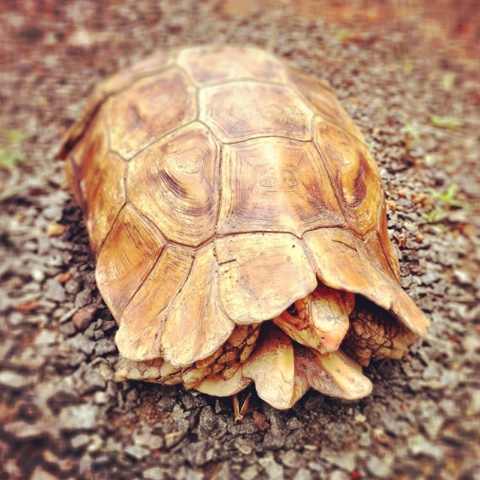
While there is usually no upside to getting stuck behind a truck in the middle of the jungle, I managed to find one. One of the ladies traveling on top of the truck, who got off the truck because it is stuck, was going to the market to sell her "goods". Goods meaning jungle tortoises. LIVE!! I saw her sitting on the mud road hoping for the truck to clear so she can make some money by selling her tortoises. At first I didn't believe that they were live and then I noticed their little heads poking out to see what is going on. I jumped in joy and immediately bought all tortoises she had (only two). The locals eat them...they would have ended up on somebody's dinner plate. Instead, they are now at Coconut Plantation House #12, safe and sound. Michael named them Samson and Delilah without knowing which one is male/ female. We realized the next day we named them correctly when Samson was looking for love from Delilah (I will spare the details!).

My local staff tell me that both tortoises are at least 50 years old considering their size, color, and rings on the shells. They are the West African Hingeback tortoises. Here is a picture of Delilah peeking out of her shell. Samson is camera shy. They like walking around the house and hiding. Who knew tortoises are fast?!


Delilah
I have a feeling my internal organs are displaced from traveling on these horrible roads, but they all seem to be functioning well. So, that's it for now. I will give the tortoises a bath while you enjoy the pictures. 

Monday, September 24, 2012

How about some tear gas with that lunch?


As some of you know, I eat lunch at a cook shop (Liberian slang for a hole-in-the-wall place) called Lowise's bar and restaurant. I shouldn’t call Lowise’s a restaurant; it is more like a shack. Heck, it doesn’t even have electricity…you have to eat in dim light even when it is sunny outside because of inadequate windows. I guess it is Lowise’s idea of a romantic lunch during the depressing rainy season. Monrovia is usually dull and dreary in the rainy season. The unrelenting rain keeps most people indoors. Despite the rain, I walk over to Lowise's at least three times a week for lunch.

Because the rain is relentless and crippling, people pour in to the streets as soon as the rain stops, even if it is for a few minutes. I am one of those people. On Friday, I walk over to Lowise’s to have some fried greens with fish and rice. I am savoring my lunch while I notice loud noises coming from outside. Now mind you, this is Monrovia, it is loud all the time. However, the loud police sirens alerted me. I got up from my unfinished lunch and walked over the entrance of Lowise’s to see what is going on. I notice police in full riot gear gathering right outside Lowise’s. I am usually unperturbed by these kind of activities, but this is Liberia; a simple demonstration can turn in to a violent life-threatening incident in a matter of few minutes. I ask the ladies serving food at Lowise’s what’s going on with the riot police. They say the Congress for Democratic Change (CDC) – the main opposition political party in Liberia – is holding a rally in protest of high unemployment rates in Liberia. Well, these kind of protests are common in many countries… it does not sound dangerous, does it?

Before I finish gathering information from the ladies, I hear people screaming from the outside and something similar to shots being fired. First instinct, duck for cover! Next thing I know there is thick smoke pouring in to Lowise’s. My eyes, nose, and throat immediately start burning. Then I realize it is tear gas. People are still screaming outside, running helter-skelter, while the ladies working in Lowise’s wrap their faces in cloth and lock the entrance door so nobody can enter from the outside.

So, here I am ducking under the table, with my eyes, nose, and throat severely burning, and no way to get out. I had nothing to cover myself and I was writhing in pain, wishing that this unprovoked tear gas attack will end fast. I waited under the table for what seemed like eternity, even though I think it may have been only 15 minutes, all the while coughing, crying, and suffering from the intense burning sensation. I call my boss while waiting and alert him to the incident. Since our office is just around the corner, he was able to witness the incident from his window, without having to inhale the tear gas like I did. After a while the ladies unlocked the door and I bolted back to my office (just around the corner). I washed my eyes and face with clean water and, like any crazy person who is addicted to work, went to a meeting.

I do not know the complete story behind the rally or the occasion for a protest by the CDC. However, from what I witnessed during lunch, the attack by riot police seems unnecessarily brutal. I saw a happy group of people singing and marching and the next thing I know the riot police are throwing tear gas at them. The sad part is that the tear gas attack happened about 100 feet away from a school. I can only imagine how terrified the children may have been. Such is the state of ruling political parties in many countries, they use brute force on opposition, sometimes without provocation. 

So, there you go folks…that was my Friday afternoon. A little tear gas served with my lunch. How did you spend your Friday?

Monday, August 20, 2012

Hello neighbor!


It's been a long time since I've posted anything. July has been hectic, to say the least. Between finalizing plans to build capacity and strengthen the health system in Liberia, digging myself out of mud roads in the jungle, and planning a short holiday in France, I was swamped. In the middle of all this hoopla, I managed to visit our neighbor - Cote d'Ivoire.

Ivory Coast, as it is know to primarily English speakers, is a sea of change from Liberia. And I mean that in a positive way. From the people to the food, I loved everything about the country. I managed to visit four places - Abidjan, Yamoussoukro, Grand Bassam, and Assinie. I felt like being in a paradise compared to Liberia.

My friends know I have been in Liberia for 7 months now. I have not once left the country. This is unusual and very difficult for someone who used to fly at least once a month for something or another. Liberia takes its toll on you. It has been work, work, and more work...with no respite. I haven't had a full 2 day weekend since February. As much as I enjoy being busy (and I LOVE my work), I was getting to a point where I needed a short break.

Enter Cote d'Ivoire. Neighbor and savior! Just a one hour flight from Monrovia lies a completely different city called Abidjan. Where there are 6 lane highways, skyscrapers, and excellent restaurants. People are friendly (even to those like me who speak broken French), and the concept of customer service exists. Heck, they even have shopping malls in Abidjan which accept credit cards. Imagine my joy when I swiped my card after 7 months. I missed shopping. Sigh!

There are so many nice things I can say about Cote d'Ivoire. First, the people. There is a sense of community in the country. Random people talk to each other on the streets and ask how you are doing. Yes, there is corruption, but the corruption is not as abrasive and aggressive as I've seen in Liberia. It is done in a more sophisticated fashion, if there is such a thing as sophisticated corruption!

I hired a car service recommended by the deputy director of USAID mission in Abidjan, who also happens to be a friend. It turned out to be a great decision, because of the language barrier. I didn't have to worry about my broken French because my driver did most of the translation for me. This arrangement enabled me to eat delicious local food without worrying about translations. I ate plenty of attieke, poisson braise, kedjenou, and fatou. Three weeks since my trips to Abidjan and I still miss poisson braise Ivorien. Fish (carp or perch) braised in herbs, onions, and tomatoes, it is simply delicious. Recipe here. Attieke (cassava couscous) turned out to be the perfect accompaniment for poisson braise. Here is a recipe for attieke with tomato-onion sauce, if you are interested. Kedjenou turned out to be another favorite of mine. Stewed chicken in spices and herbs, it is a delicious dish.

Kedjenou and attieke

Then there was agouti stewed in a bitter eggplant sauce. Agouti, also known as "rat de brousse" in French, is basically a bush rat. It is also known as groundhog, or grass cutter if you are in Liberia. While devouring the dish I realized I am eating a giant rat. Oh well, a tasty rat! Lastly, but certainly not the least, I had sauce djoumble. It is the Ivorian version of gumbo...dried okra helps thicken the sauce. Although it is usually served with fish, I had it with pintade (Guinea fowl). One of my guilty pleasures is fried food. You have no idea how happy I was when I found fried donut-like items in Abidjan. Even better, it was street food. The only thing that makes friend food better is when it made on the street in a busy market. Look at the woman making the donuts in the Adjame market...doesn't it look tasty?

Deep fried dough in the Adjame market

I devoured the wami (sp?) like a famished person. Deep friend millet dough never tasted so good!!

Wami (sp?)
I talk about food often. To me, food is a top indicator of a culture. I prefer to experience a culture first hand through food. A complex and delicious cuisine is an indicator of a rich and intriguing culture. At least that's my theory and I am sticking to it. If the local cuisine of Cote d'Ivoire is any indication, it is a highly cultured society.

One of the highlights of Abidjan is the zoo. Granted it is in a sad state after the recent civil war, but I was thrilled to see a few animals....particularly, Marguerite the pygmy hippo. I also hand fed an elephant, watched a baboon expose itself to me in a sexually grotesque manner, and met the 150 year old giant tortoise that traveled from Sierra Leone zoo to Abidjan zoo. Feel free to browse through my pictures (click the picture below for a slideshow) or click here for the complete album.


I also visited Yamoussoukro, the capital of Cote d'Ivoire. I did a day trip to Yamoussoukro with the expert driving of Marcellin, my driver. The roads of Cote d'Ivoire, unlike the roads of Liberia, enable you to drive 300km in under 3 hours. The same distance takes me 7 hours in Liberia. Crocodiles, cacao trees, coffee plantations, papaya plantations and loads of fun. I visited President Houphouet-Boigny's mansion, his private crocodile lake, and all the huge crocodiles that live in the lake.

In Yamoussoukro I visited the Basilica of our Lady of Peace. Listed in the Guinness Book of World records as the largest church in the world, larger than the St. Peter's Basilica in the Vatican, the Basilica or Our Lady of Peace was built between 1985 and 1989 with a budget of US$ 300million. It is a reminder of the glorious times of Cote d'Ivoire, when the country was stable with a booming economy. I did not like the Basilica. It is a large and grotesque structure with no character. It feels like the architect and the government wanted to construct something to attract world's attention and did not care about the aesthetics. It feels very sterile and plastic to be inside this mammoth structure. I even ate ripe coffee fruits. Yummy! Check out my Yamoussoukro picture album.  The highlight of my trip to Yamoussoukro was visiting the cacao and coffee plantations (see album link for pics).

My crocodile friends, just relaxing in the president's private lake!

A day after Yamoussoukro, I visited Grand Bassam and Assinie. Grand Bassam was the first capital of Cote d'Ivoire. There is a lot of history associated with Bassam from French colonial times. The museum director opened the museum exclusively for me, even though they were closed on that particular day. I got my own private showing of the culture and tribes of Cote d'Ivoire. Splendid!

Assinie (pictures here) is what I like to call "the Hamptons of Cote d'Ivoire". Beautiful mansions on the beach, lovely restaurants, and the playground of the Ivorian elite, Assinie is definitely a place to relax and have fun. The beach is beautiful, the food is stellar, and the people are friendly. A perfect vacation spot if you ask me. Perhaps I will go back and rent one of those beautiful beach mansions for a weekend.

Assinie

After five glorious days in Cote d'Ivoire it was time to come home. The only disappointment I have is that Abidjan is so close (only a one hour flight), yet it is impossible to go just for a weekend. The flight schedule is not helpful to take weekend trips. Perhaps that is a good thing...because I would spend every other weekend in Abidjan if the flight schedule was enabling. I look forward to returning soon.

Thursday, June 14, 2012

When the clouds come rolling in...

Last week I traveled to Sanniquellie for two reasons. One was to conduct a workshop for the health workers on using data for making decisions. The other reason was to explore why contraceptive use is very low in Nimba County. I will write about those two parts later, I have to talk about the drive to Sanniquellie.


The better part of the road - with few potholes and washed away at its seams
I like driving up country, or as the Liberians call it, "the bush". The drive from Monrovia to Sanniquellie is quite the feat, because of the road. I haven't been to Sanniquellie in a month, so I wasn't aware of the condition of roads. The terrain changes rapidly in the rainy season, because it doesn't just rain here. The rain in Liberia is unlike any other. It is powerful enough to wash away everything in its path. To give you an idea, Liberia received the third largest rainfall in the world, for its land area. Monrovia is the city with the highest rainfall in the world. Since the rainy season started a month ago, I wasn't quite sure what lay ahead in front of us. Well, not much lay ahead. The dirt road that has washed away in most areas leaving huge potholes the size of craters, and rocks. Part of the road is paved. the part from Monrovia to Gbarnga is not bad, the part from Gbarnga to Ganta is the worst, and from Ganta to Sanniquellie is just track. Half of our journey is spent clinging on to our dear lives on the hand railing in our Land Cruiser. I do not recommend anyone with a bad back doing this trip.

However, not all is bad. The scenery is beautiful. That's what happens when you drive through the last remaining rain forest in West Africa. Lush tropical forest lines either sides of the road. Huge rubber trees stand majestically among the underbrush. The Liberian rain forest is also the world's only known habitat for pygmy hippos. I haven't seen one in the wild so far, because they are rare, shy, and highly endangered.

Since it is the rainy season, and these are no ordinary rains, you always are caught in a downpour. The sight of a rain storm rolling in always enthralls me. The colors - green luscious forest, red dirt road, the blue sky, and black clouds rolling in with immense speed - is quite the sight to see. Although I am no professional photographer, I tried to capture some of the intense beauty with my simple yet trusty Canon Powershot.

The clouds roll in...

What you see on the right is a small hamlet, three huts bordered by plantain and coconut trees. I asked our driver to stop in the middle of the track so I can marvel at the beauty of nature. I started taking pictures and a man came out of one of the huts to see what we were doing. After some more picture taking, we resumed our bumpy journey.

The dark sky and darker road

As we pass through more forest and start driving through the heavy downpour, we are greeted with various sounds from the forest, people running to their huts to avoid the rain, and, my most favorite of all, the smell of  earth when it receives rain. After about an hour of driving, we finally get past the rain, and start watching for the huge puddles on the road. It is a good thing we have the trust Land Cruiser, you cannot do this drive with many SUVs.

One of the things you have to be cautious of this rain is the huge puddles that form in the road. It is difficult to  avoid and gauge the depth of these puddles, which leads to many accidents. These are no ordinary puddles, they can swallow half of your car easily. We witnessed one such accident. A semi-truck that got stuck in one such puddle because it was too deep. The semi kinda nosedived in to one puddle while avoiding another puddle. Luckily there were no casualties, just a semi stuck on the road. This does not bode well for us, because you cannot take a diversion.


Accident!

Now, you may wonder why there is a big semi in the middle of the rain forest? It is because one of the largest iron ore mines in Africa is located near the Liberia-Guinea border, in a town called Yekepa. You have to pass through the rain forest to reach Yekepa. Arcelor Mittal has a huge mining operation going on in Yekepa, and this particular truck was delivering some supplies to the mine.

We got out of our SUV, walked around to see if there is any clearing on the side of the road and decided to take a chance with off-roading. There is no way we are staying stuck in the forest behind this semi, while it is getting dark. Look at my boss and our driver surveying the terrain.


My boss and driver surveying the terrain before deciding if we can off-road

My boss drove Land Cruisers in the rain forests of Cameroon 30 years ago, while volunteering as a physician in the jungles of Cameroon and Congo. He has worked extensively in Africa and he has a great knowledge of the terrain. With his and our trusty driver's skills, we were able to get out of this road block. Look at our intern waiting patiently and watching the scene.


Heather waits patiently while enjoying the scenery

That's our trusty Land Cruiser, by the way. Almost all international donors and NGOs working in Liberia have white vehicles. The rhino horn looking thing in front of the car is for our satellite phone, if we get stuck in the jungle and need the American government to come get us :) After some maneuvering, we were able to get on the road and resume our journey. We got out to see the accident from the front and it looked like this...


The accident from the front

Well, that crash could have easily been us. But we have skilled drivers, so I rarely get worried about driving through the rain forest. Just look at that lush greenery on either sides of the road. Stunning!

We go on with our journey and arrived at Sanniquellie safely. Finished work in two days and came back to Monrovia. I bought a big bag of palm nuts for Isaiah on the way back home. He is one happy bird!


Wednesday, May 23, 2012

Birthday celebration in Liberia

On Monday, May 21, I turned another year older. Not any wiser, mind you!

In a country severely lacking in fun things to do, how does one celebrate a birthday? Or any special occasion? Well, you adapt to the local situation and make it simple. I still tried to make the best of it with the help of family.

The day before my birthday, I received the best gift. A coffee maker!! I know, I know! You all probably think what's so special about a coffee maker? Well, let me tell you what makes it special. There is no such thing as decent coffee in this entire country. People here drink instant coffee. If you are someone like me, who is used to living on 8-10 shots of espresso per day and a gallon of coffee, you will find this country absolutely horrid. In my knowledge, there is only one place in the entire country that serves filter coffee and espresso. And that depends on the day. Some days they don't have either. Sometimes it feels like it is easier to obtain blood diamonds and illegal wildlife than finding a decent cup of coffee. So, imagine my joy when I received a coffee maker! I was so thrilled that I thought of sleeping next to it in the kitchen.

On the day of my birthday, in stereotypical Indian tradition, I arranged a party for my colleagues. Americans usually do it the other way around, but we Indians see it as our responsibility to feed people who have come to wish you. So, I arranged for lunch. Potato greens and rice...the quintessential Liberian dish. It also happens to be my favorite Liberian food. We took a group picture before lunch.

Group hug! Look at me in green!!
After eating a bucket load of potato greens with rice, I had to be wheeled out of the conference room in to my office. My gluttonous self was already thinking about dinner. We went to one of the "fancy" places in town, and there is a reason why I put the word fancy in quotes. It is one of the few places in town where you can get somewhat reliable service and good food, besides cocktails. Barracuda Sushi Bar is housed in the famous Mamba Point Hotel, within walking distance to our house. The sushi is good, the ambiance is pleasant, and they have limited cocktails.

After coming home from dinner, I received the second birthday present. Although I am unable to see it in person, I am most excited for it. It is a Heidi Norton sculpture. The artist will be shown at the Chicago Museum of Contemporary Art starting August. The sculpture I/we own is listed on her website, but I am posting a picture here as well. It is a mixed media + live object sculpture, with a living fern and other objects encased in resin. Even though I haven't seen it live, I am absolutely fascinated by it. I cannot wait until I return to the US and see it in our home.

Heidi Norton sculpture
Despite living in Liberia away from most of my friends and family, I managed to have a wonderful celebration because of one person. At the end of the day, all that matters is that we are together.


Monday, May 14, 2012

The first and only comprehensive assessment of capacity of the health system in Liberia - finally!!


Capacity building seems to be the buzz term in Liberia. Everybody and their mother talks about building capacity! I am not even joking when I say everyone from the international donor community to local pen-pen drivers use the term capacity building. Sometimes it feels like people are just using the term because it makes them look "cool". Almost every NGO and donor agency has a line item for capacity building in their work plan. There is even a national capacity building strategy document for Liberia. If I had a nickel for every time someone used the term capacity building!

Don't get me wrong! I strongly believe in building capacity. However, I get frustrated sometimes because the term is used very loosely. Many people who are in the business of building capacity in Liberia see it from a very narrow point - the point being training individuals to build workforce capacity. For someone like me who has spent a majority of his professional life strengthening systems, it is a bothersome view. Training workforce is one of the three components of capacity building; it should not be the only focus. An individual functions well in a system that enables her/ him to put their skills to good use. You cannot just train individuals and leave them to work in a system that is not conducive to working efficiently and effectively. Strengthening individual capacity and system has to happen simultaneously if we want to achieve maximum results. Allow me to give you an example. We often hear people being trained in Monitoring and Evaluation (also known as M&E for the geeks in international aid community). I personally know plenty of local workforce that has been trained in M&E as a part of building their capacity. However, the system under which an M&E professional works is not always enabling them to use their training. How can a trained M&E person be productive when s/he is lacking a data collection and reporting system? What kind of functions will a trained person perform when they do not even have a job description? What kind of data analysis can be performed and how is the data used towards decision making when there is no mechanism/ system to analyse data and distribute the findings to key stakeholders?

The above example is just one of the numerous instances where a narrow focus on capacity building does not yield intended results. More often than not the NGO and donor community tends to focus narrowly and not see the big picture. While there are situations where a focus on individual capacity takes precedence, one must always keep the institutional and systems perspectives in mind. For example, immediately following conflict there was a great need for qualified workforce in Liberia. Majority of the resources were focused on building workforce capacity, which, at that time, was thoroughly justified. Now that foreign aid is dwindling and Liberia is moving in to a phase of planning for sustainability, the time is ripe for building comprehensive capacity, not just individual capacity.

That is exactly why my/ our project's approach towards building capacity is comprehensive. The approach is comprehensive; I/we focus on three levels of building capacity - individual, organization, and system. 


A notice pinned on the main notice board of Lofa County Health System announcing our assessment and  "mandating" participation

As mentioned in one of my previous posts, I am following the WHO six building blocks of a health system framework. There are two reasons for this: 1. The Liberian National Health and Social Welfare Policy and Plan (NHSWPP) is designed around the same framework 2. The framework is flexible enough to adapt to various situations and country systems and allows us to assess the health system in a comprehensive manner.

For anyone who has ever designed/ conducted/ participated in a health system assessment, I do not have to reiterate the fact that it is an extremely tedious process. As tedious - and sometimes frustrating - as it might be, it is immensely satisfying for geeks like me. It is very rare that an entire system comes together to assess performance, capacity, and functions. We finished the county level assessments two weeks ago and we just wrapped up our central assessments.

Key respondents and staff conducting the assessment in Lofa County

The county assessments were conducted in three counties - Lofa, Nimba, and Bong. They took place over a period of two weeks - two days for each county assessment + travel time in between. A team of us - from the ministry and our project - traveled to each county to conduct the assessments. I am not ready to share the results of all assessments yet, but I will say there is a lot of work to be done. No surprise there!

We are now moving in to the phase of analyzing our data and writing a report about our findings. I can already tell there are a few areas that we need to focus - performance management, pharmaceutical supply chain management, data use for evidence-based decision making, and organizational restructuring. The last one is going to be interesting to pull off, because people are usually resistant to change, especially when it comes to restructuring. There is vast disconnect between what the central ministry perceived the capacity to be at the county level and the actual capacity. We need to address this disconnect if we have to move forward with strengthening the health system.

I always seek feedback from respondents immediately following an assessment. One of the statements that gives me satisfaction and makes it all worth is when the respondents said (I am paraphrasing here) "many people have come and gone in the name of capacity building assessments...you are the first person who has approached it comprehensively and has a plan". I will share the results once we finalize the report with feedback from the ministry. Until then, I am going to be spending numerous late nights writing the results and a plan of action.

I promise I will write something fun in the next post...food or about animals :)